Authenticate a customer with a single OTP and return a fully-scoped access token.
The auth frame is the lowest-friction way to obtain a fully-scoped access token. The customer verifies an email or SMS one-time passcode and, on success, the frame returns encrypted authenticated credentials that your client can use to call the MoonPay API on the customer’s behalf — for example to submit KYC information, fetch transactions, or perform other account-level operations.
The auth frame should only be launched after the check frame returns connectionRequired. The customer’s email address and optionally phone number (passed when you create a session) is how MoonPay identifies the user and where the one-time passcode is delivered:
If MoonPay has a phone number on file for that user, the customer can choose to receive the code via SMS instead. If not, email is the only option.
The customer does not need to be a returning MoonPay user. If no MoonPay account exists for the email yet, one is created during the OTP step. You can then drive any required onboarding or verification through other frames or directly via the API with the returned access token.
Make sure the email you pass when creating the session matches the customer’s MoonPay account. If you send the wrong email — for example, a fresh address for a customer who already has an account under a different email — the auth flow will provision a brand-new account against the address you provided.The customer can later reverify with the correct email, but the duplicate account will be flagged. If a duplicate is detected, the customer will later be asked to resolve it through a challenge flow during verification.Use the full connect frame instead when you want MoonPay to orchestrate onboarding (KYC, address, document collection) inside the same flow.
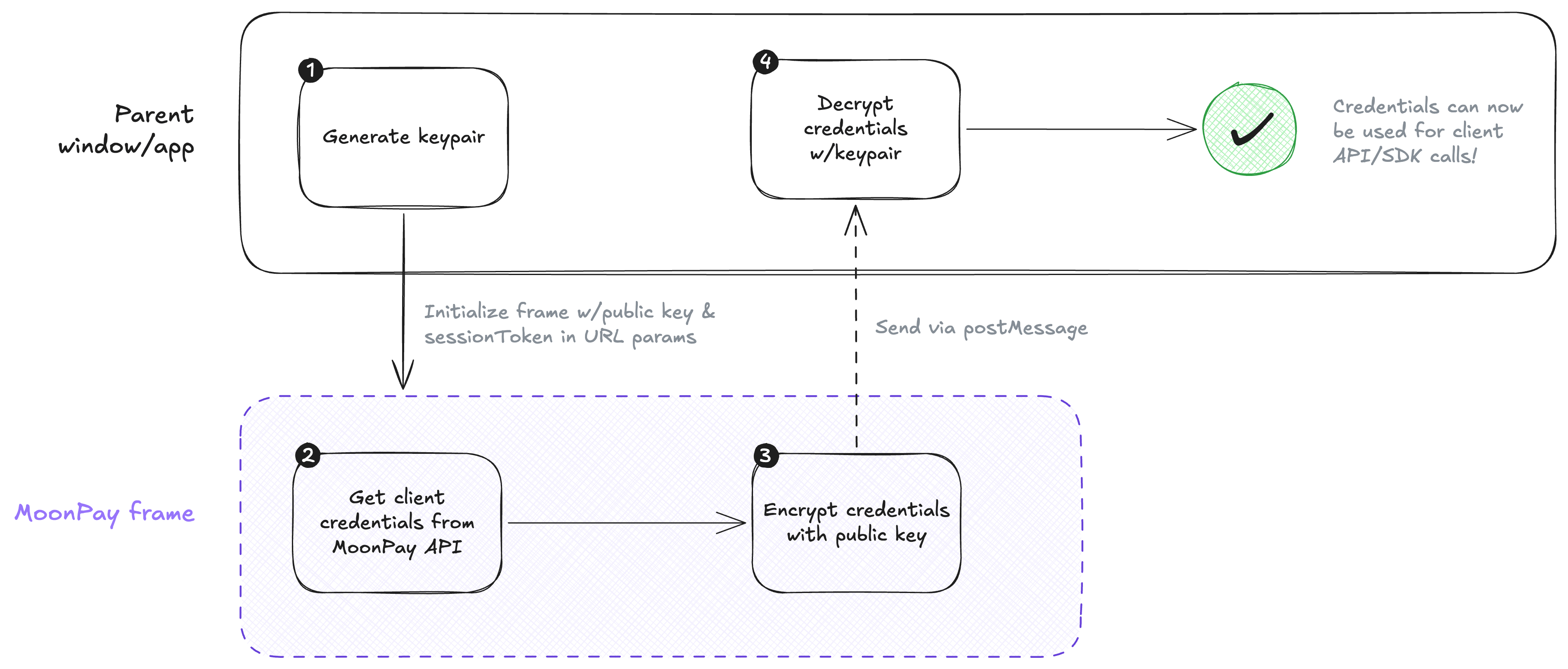
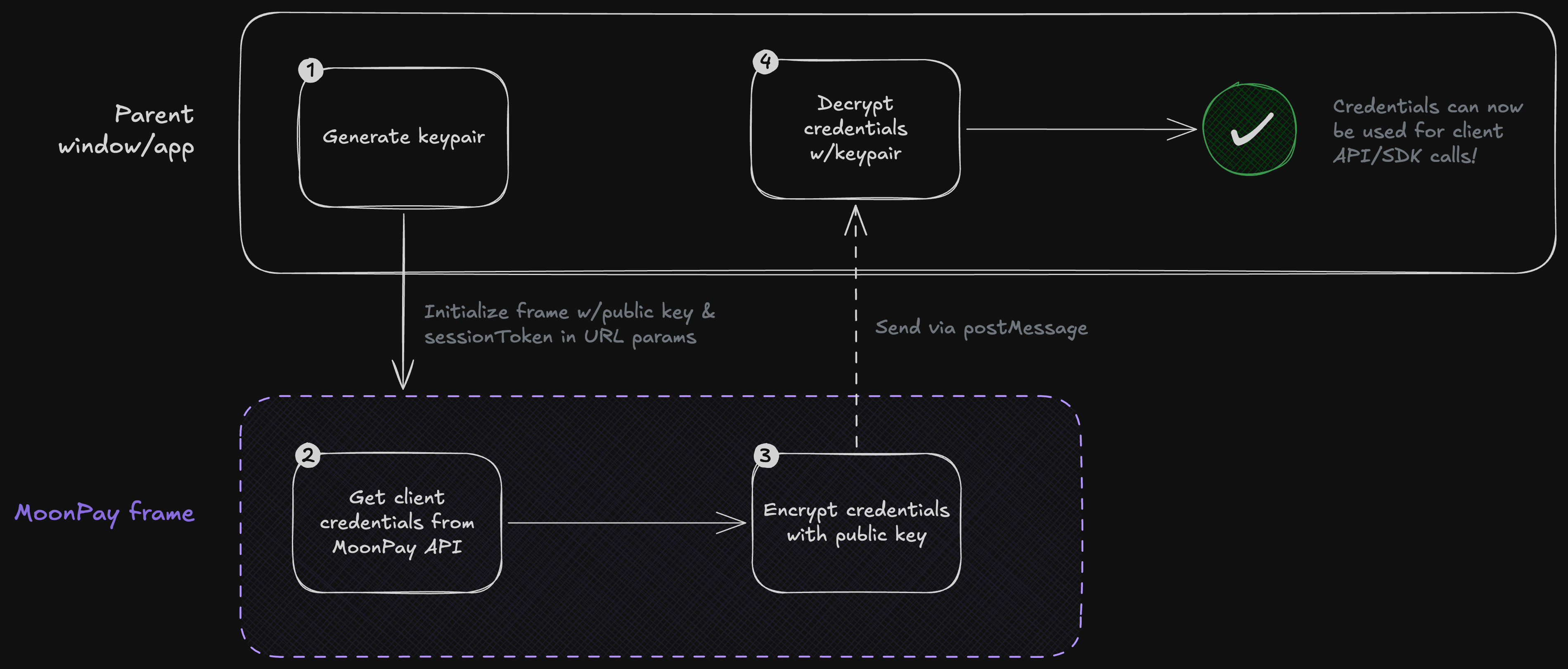
Credentials returned from the frame are encrypted to protect their content since they are sent over postMessage. You need to generate an X25519 keypair and pass the public key into the frame. The frame uses your public key to encrypt the payload, ensuring only you can read it with your private key.
Never persist the private key to disk or storage. Hold it in memory only for
the duration of the session.
The frame uses the @noble/curves library internally. On web and React Native, you can use this same library to generate your keypair and handle decryption. For native platforms, use a compatible utility like CryptoKit on iOS or KeyPairGenerator on Android.
Example crypto module for web
The following example shows how to generate a keypair and decrypt credentials using @noble/curves. You’ll want to add your own error handling and input validation for production use.
pnpm i @noble/curves @noble/hashes @noble/ciphers
bun add @noble/curves @noble/hashes @noble/ciphers
npm i @noble/curves @noble/hashes @noble/ciphers
crypto.ts
// An example module for generating keypairs and decrypting client credentials.// This should not be used as-is in production!import { gcm } from "@noble/ciphers/aes.js";import { x25519 } from "@noble/curves/ed25519.js";import { hkdf } from "@noble/hashes/hkdf.js";import { sha256 } from "@noble/hashes/sha2.js";/** The credentials returned from the connect flow. */export type ClientCredentials = { /** A JWT used to authenticate client requests to the Moonpay API. */ accessToken: string; /** A JWT used to initialize authenticated frames such as Apple Pay. */ clientToken: string; /** An [ISO 8601 timestamp](https://developer.mozilla.org/en-US/docs/Web/JavaScript/Reference/Global_Objects/Date/toISOString) representing the expiration time of the tokens. */ expiresAt: string;};/** X25519 `privateKey` and `publicKey`as hex strings. */export type KeyPair = Record<"privateKey" | "publicKey", string>;export type DecryptClientCredentialsResult = | { ok: true; value: ClientCredentials } | { ok: false; error: string };const hexToBytes = (hex: string): Uint8Array => { if (hex.length % 2 !== 0) { throw new Error("Invalid hex string"); } const bytes = new Uint8Array(hex.length / 2); for (let i = 0; i < bytes.length; i++) { bytes[i] = parseInt(hex.substr(i * 2, 2), 16); } return bytes;};const bytesToHex = (bytes: Uint8Array): string => { return Array.from(bytes) .map((b) => b.toString(16).padStart(2, "0")) .join("");};/** Decrypts an encrypted `ClientCredentials`. */export const decryptClientCredentials = ( /** A base64-encoded string representing the encrypted JSON payload. **/ encryptedCredentials: string, /** The recipient's X25519 private key as a hex string. **/ privateKeyHex: string,): DecryptClientCredentialsResult => { // Base64 decode the encrypted credentials const payload = atob(encryptedCredentials); // Guard and validate this deserialization const parsedPayload = JSON.parse(payload); // Convert the private key from a hex string to a `Uint8Array` const privateKey = hexToBytes(privateKeyHex); // Convert the ephemeral public key from a hex string to a `Uint8Array` const publicKey = hexToBytes(parsedPayload.ephemeralPublicKey); const ivBytes = hexToBytes(parsedPayload.iv); const ciphertextBytes = hexToBytes(parsedPayload.ciphertext); const sharedSecret = x25519.getSharedSecret(privateKey, publicKey); const encryptionKey = hkdf(sha256, sharedSecret, undefined, undefined, 32); const cipher = gcm(encryptionKey, ivBytes); const plainTextBytes = cipher.decrypt(ciphertextBytes); const plaintext = new TextDecoder().decode(plainTextBytes); let parsed: unknown; try { parsed = JSON.parse(plaintext); } catch { return { ok: false, error: "Failed to parse decrypted payload as JSON" }; } // Validate the decrypted payload if ( typeof parsed !== "object" || parsed === null || typeof (parsed as Record<string, unknown>).accessToken !== "string" || typeof (parsed as Record<string, unknown>).clientToken !== "string" || typeof (parsed as Record<string, unknown>).expiresAt !== "string" ) { return { ok: false, error: "Decrypted payload missing required fields" }; } return { ok: true, value: parsed as ClientCredentials };};/** Generates a new X25519 key pair encryption. */export const generateKeyPair = (): KeyPair => { const { secretKey: privateKey, publicKey } = x25519.keygen(); return { privateKey: bytesToHex(privateKey), publicKey: bytesToHex(publicKey), };};
Example crypto module for React Native
The following example shows how to generate a keypair and decrypt credentials using @noble/curves. You’ll want to add your own error handling and input validation for production use.In React Native, yuo will need a polyfill for getRandomValues (MDN) which is only available in browsers.
pnpm i react-native-get-random-values @noble/curves @noble/hashes @noble/ciphers
bun add react-native-get-random-values @noble/curves @noble/hashes @noble/ciphers
npm i react-native-get-random-values @noble/curves @noble/hashes @noble/ciphers
crypto.ts
// An example module for generating keypairs and decrypting client credentials.// This should not be used as-is in production!import { gcm } from "@noble/ciphers/aes.js";import { x25519 } from "@noble/curves/ed25519.js";import { hkdf } from "@noble/hashes/hkdf.js";import { sha256 } from "@noble/hashes/sha2.js";// React Native polyfill for getRandomValuesimport "react-native-get-random-values";/** The credentials returned from the connect flow. */export type ClientCredentials = { /** A JWT used to authenticate client requests to the Moonpay API. */ accessToken: string; /** A JWT used to initialize authenticated frames such as Apple Pay. */ clientToken: string; /** An [ISO 8601 timestamp](https://developer.mozilla.org/en-US/docs/Web/JavaScript/Reference/Global_Objects/Date/toISOString) representing the expiration time of the tokens. */ expiresAt: string;};/** X25519 `privateKey` and `publicKey`as hex strings. */export type KeyPair = Record<"privateKey" | "publicKey", string>;export type DecryptClientCredentialsResult = | { ok: true; value: ClientCredentials } | { ok: false; error: string };const hexToBytes = (hex: string): Uint8Array => { if (hex.length % 2 !== 0) { throw new Error("Invalid hex string"); } const bytes = new Uint8Array(hex.length / 2); for (let i = 0; i < bytes.length; i++) { bytes[i] = parseInt(hex.substr(i * 2, 2), 16); } return bytes;};const bytesToHex = (bytes: Uint8Array): string => { return Array.from(bytes) .map((b) => b.toString(16).padStart(2, "0")) .join("");};/** Decrypts an encrypted `ClientCredentials`. */export const decryptClientCredentials = ( /** A base64-encoded string representing the encrypted JSON payload. **/ encryptedCredentials: string, /** The recipient's X25519 private key as a hex string. **/ privateKeyHex: string,): DecryptClientCredentialsResult => { // Base64 decode the encrypted credentials const payload = atob(encryptedCredentials); // Guard and validate this deserialization const parsedPayload = JSON.parse(payload); // Convert the private key from a hex string to a `Uint8Array` const privateKey = hexToBytes(privateKeyHex); // Convert the ephemeral public key from a hex string to a `Uint8Array` const publicKey = hexToBytes(parsedPayload.ephemeralPublicKey); const ivBytes = hexToBytes(parsedPayload.iv); const ciphertextBytes = hexToBytes(parsedPayload.ciphertext); const sharedSecret = x25519.getSharedSecret(privateKey, publicKey); const encryptionKey = hkdf(sha256, sharedSecret, undefined, undefined, 32); const cipher = gcm(encryptionKey, ivBytes); const plainTextBytes = cipher.decrypt(ciphertextBytes); const plaintext = new TextDecoder().decode(plainTextBytes); let parsed: unknown; try { parsed = JSON.parse(plaintext); } catch { return { ok: false, error: "Failed to parse decrypted payload as JSON" }; } // Validate the decrypted payload if ( typeof parsed !== "object" || parsed === null || typeof (parsed as Record<string, unknown>).accessToken !== "string" || typeof (parsed as Record<string, unknown>).clientToken !== "string" || typeof (parsed as Record<string, unknown>).expiresAt !== "string" ) { return { ok: false, error: "Decrypted payload missing required fields" }; } return { ok: true, value: parsed as ClientCredentials };};/** Generates a new X25519 key pair encryption. */export const generateKeyPair = (): KeyPair => { const { secretKey: privateKey, publicKey } = x25519.keygen(); return { privateKey: bytesToHex(privateKey), publicKey: bytesToHex(publicKey), };};
The anonymous client token obtained after decrypting the credentials returned by the check frame when the status is connectionRequired.
publicKey
string
✅
An ephemeral public key generated on the client. See requirements for details.
The frame uses this key to encrypt the client credentials returned from the auth flow.
channelId
string
✅
A unique identifier for the frame generated on your client. This value is attached to each postMessage payload to help identify messages.
The format of this string is up to you.
partnerName
string
The partner name to display in the frame UI. Typically set by the SDK from the session token — only override this if you’re integrating directly without the SDK.
partnerLogo
string
The partner logo to display in the frame UI. Typically set by the SDK from the session token — only override this if you’re integrating directly without the SDK.
brandColor
string
A 6-digit hex color (with or without leading #) used as the partner brand color in the frame UI. Invalid values fall back to the MoonPay default.
customTheme
string
A JSON-stringified theme-override object. Supports borderRadius, colorScheme (auto/light/dark), and palette.semanticColors (positive/negative/caution hex). Invalid or oversized values fall back to the MoonPay default.
autoFocus
boolean
Whether the one-time passcode input is focused automatically when the frame loads. Defaults to true. Pass false if your app manages focus itself (for example, to avoid the mobile keyboard opening before the frame is visible).
The frame has loaded and dispatched the customer’s first one-time passcode. Use this to reveal the frame and drop any loading state you were showing in its place.
The auth flow finished. The payload is a Connection object whose status field tells you the outcome:
active — the customer is authenticated. The payload includes the customer’s id and encrypted authenticated client credentials. Any outstanding KYC or onboarding requirement is surfaced through capabilities, not a separate status — use the returned access token to drive it.
termsAcceptanceRequired — the customer must accept updated Terms of Use before the connection can be used. No credentials are attached: display the Terms of Use in your own UI, capture the acceptance timestamp, pass it as termsAcceptedAt when you create a new session (POST /platform/v1/sessions), then relaunch the flow. Passing termsAcceptedAt requires the Identity or Guest Checkout account capability.
pending / unavailable — status-only completions with no credentials: the connection exists but isn’t currently usable (a KYC decision is still pending, or the customer is in a restricted location).
typeMessage<T> =T & {version: 2;meta: { channelId: string };};enumConnectionStatus { /** The connection is valid and can be used. **/active = "active", /** The customer must accept updated Terms of Use before the connection can be used. **/termsAcceptanceRequired = "termsAcceptanceRequired", /** A KYC decision is still pending; the connection is not yet usable. **/pending = "pending", /** The connection cannot be used (for example, a restricted location). **/unavailable = "unavailable",}typePaymentDisclosuresRequirement = { /** The customer's ISO 3166-1 alpha-3 residential country code. E.g. `"USA"` or `"FRA"` */country: string; /** The state or province code, when disclosures apply to a subdivision. E.g. `"NY"` or `"WA"` */administrativeArea?: string; /** The broader regulatory area for the country, when applicable. Currently `"EEA"`. */area?: string;};typeCustomerCapabilities = {ramps: {requirements: { /** Present when disclosure geography is available. Use `country`, `administrativeArea`, and `area` to determine which disclosure, if any, applies. **/paymentDisclosures?:PaymentDisclosuresRequirement; }; };};typeActiveConnection = {status:ConnectionStatus.active; /** The authenticated MoonPay customer. **/customer: { id: string }; /** Encrypted client credentials containing the accessToken and clientToken. Once decrypted, the value contains a stringified JSON object with the following structure: * * { * "accessToken": "<token>", * "clientToken": "<token>", * "expiresAt": "<iso8601>", * } * * - `accessToken`: A fully-scoped token that can be used to make authenticated API requests on behalf of the customer. * - `clientToken`: A token that can be used to initialize sensitive frames such as Apple Pay. * - `expiresAt`: An ISO 8601 formatted string indicating when the tokens expire. **/credentials: string; /** Regulatory capabilities for the authenticated customer. Present only when there is a requirement to surface; omitted otherwise. **/capabilities?:CustomerCapabilities;};typeTermsAcceptanceRequiredConnection = {status:ConnectionStatus.termsAcceptanceRequired;};typePendingConnection = {status:ConnectionStatus.pending;};typeUnavailableConnection = {status:ConnectionStatus.unavailable;};typeAuthCompleteEvent =Message<{kind: "complete";payload: |ActiveConnection |TermsAcceptanceRequiredConnection |PendingConnection |UnavailableConnection;}>;
This event dispatches errors that occur in the flow. The error message is developer-facing and not intended to be rendered in UI.The frame emits this event for every terminal error so the parent always knows when the flow has failed and can tear down the iframe or surface a fallback in your app. Recoverable mistakes the customer can retry inside the frame (such as an invalid or expired code) are not reported through this event — see Error handling for the full breakdown.Terminal errors that occur during the flow carry code: "generic". Invalid initialization parameters — a missing or malformed clientToken, publicKey, or channelId — are instead reported with code: "validationError" and a list of the offending fields, before the OTP flow starts.
typeMessage<T> =T & {version: 2;meta: { channelId: string };};typeValidationFieldError = { /** Which initialization parameter failed validation. */code: "invalidClientToken" | "invalidPublicKey" | "invalidChannelId";message: string;};typeAuthFlowError =Message<{kind: "error";payload: | { /** A terminal failure during the flow. */code: "generic"; /** A developer-facing error message with details on recovery or documentation. This message is not intended to be rendered in UI. */message: string; } | { /** One or more initialization parameters were missing or malformed; emitted before the flow starts. */code: "validationError";errors:ValidationFieldError[]; };}>;
The auth frame splits failures into two categories. Inline errors are handled silently inside the frame so the customer can retry without the parent doing anything. Terminal errors end the flow — the frame shows a full-screen error state to the customer and sends an error post-message to the parent at the same time, so your app can react (for example, by tearing down the iframe or surfacing a fallback).
These are recoverable mistakes the customer can fix without leaving the OTP screen. The frame shows an inline message under the code input and stays open so the customer can retry. The parent does not receive an error event for these.
Scenario
Message shown to the customer
Wrong code entered
”That doesn’t look right, try a new code”
Code has expired
”That code is old, try a new one”
Rate limit hit when resending a fresh code
”Too many requests. Try again later.” (shown briefly as an auto-clearing hint; the customer can wait out the cooldown and try again)
These end the flow. The frame replaces its content with a full-screen error state — depending on the cause, the customer is offered a Retry button, a Close button, or both. The parent always receives an error event with code: "generic" for every terminal error, so it can dismiss the iframe or surface a fallback in your app.
Scenario
Message shown to the customer
Too many failed code attempts
”Too many failed attempts. Please try again later.”
OTP session expired before the customer entered the code